

Rosas danst Rosas
Anne Teresa De Keersmaeker / Rosas
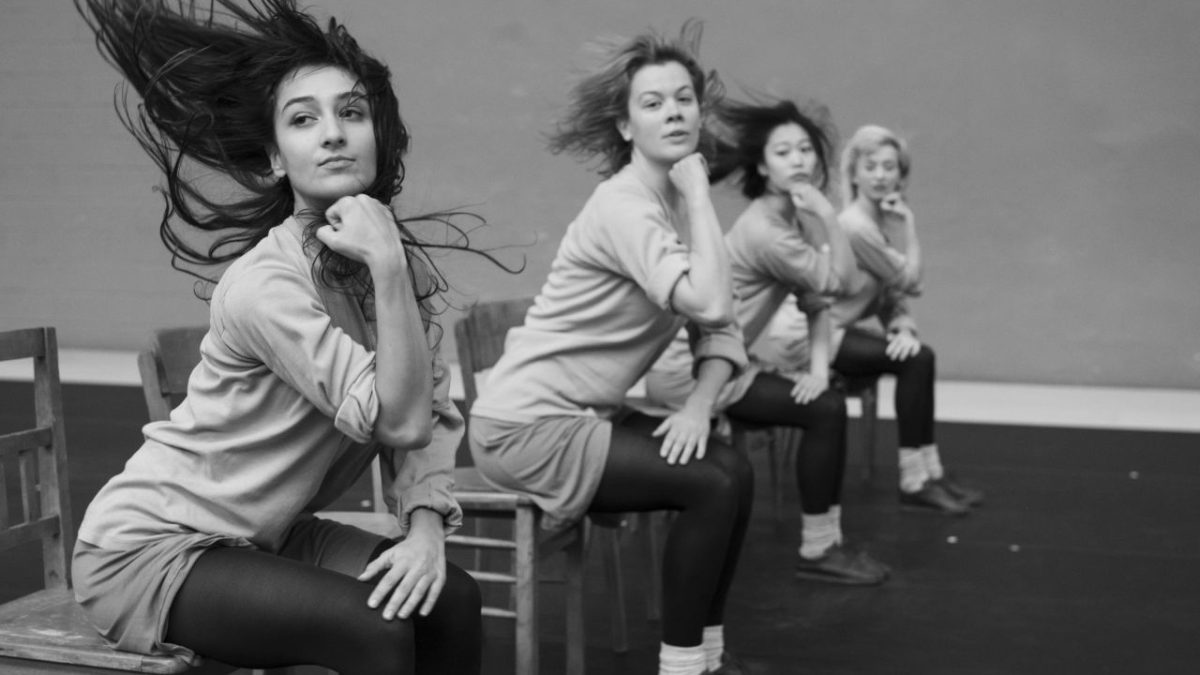
In 1983, Anne Teresa De Keersmaeker had her international breakthrough with Rosas danst Rosas, a performance that has since become a benchmark in the history of postmodern dance. Rosas danst Rosas builds on the minimalism initiated in Fase (1982): abstract movements constitute the basis of a layered choreographic structure in which repetition plays the lead role. The fierceness of these movements is countered by small everyday gestures. Four female dancers dance ‘themselves’, over and over again. Their perseverance and exhaustion result in an emotional charge that contrasts sharply with the rigorous structure of the choreography. The repetitive, “maximalistic” music by Thierry De Mey and Peter Vermeersch was created concurrently with the choreography. This restaging of Rosas danst Rosas will be danced by a completely new cast.
| Files |
|---|
| File |
| Technical rider |
|---|
| Technical rider |
Rosas
Anne Teresa De Keersmaeker- Genre: Dance
- World premiere: 4 February 2026 Rosas Performing Space Brussels (BE)
- Creation & performance: Choreography: Anne Teresa De Keersmaeker | Dancers: Jasmine Achtari, Eva Galmel, Nina Godderis, Momiji Kuromaru
- Costumes: Rosas
- Music: Thierry De Mey, Peter Vermeersch
- Coproduction: De Munt / La Monnaie (Brussel/Bruxelles), Sadler’s Wells (London), Les Théâtres de la Ville de Luxembourg
- With the support of: With the support of Dance Reflections by Van Cleef & Arpels. Rosas is supported by the Flemish Community and the Flemish Community Commission (VGC).
"Rosas Danst Rosas saw four energetic dancers layering quotidian movements onto one another as they harnessed the power of repetition and variation to create a hypnotic spectacle that acted as a visual analogue to techno."
InDaily, Inside South Australia
"What we saw last night in Madrid proves that minimalism—when it has a human pulse—is indestructible."
Susy Q
"The piece has not aged precisely because it is not about trends, but about the relationship between body, space, and time. It is not nostalgia for the 1980s, but respect for a work that, more than forty years later, is still capable of hypnotizing an overstimulated audience through pure repetition and silence. And that, in these times, undoubtedly deserves every round of applause and standing ovation it received last night. Bravo."
Susy Q
"It is generous and valuable that this work continues to be revived and made accessible to younger generations of dancers, who are often immersed in a turbulent sea of fleeting trends and superficial creations. Keersmaeker offers a work that has been part of the repertoire for over four decades and has not aged at all."
Scherzo
"Riveting and exhausting, fascinating and relentless, brilliant and tedious, it is a mesmerizing exploration in synchronicity, patterning and rhythm."
The New York Times, 2011